

Oral Appliance Therapy for Sleep Apnea in Houston, TX
A Comfortable CPAP Alternative for Better Sleep and Better Health
If you've been diagnosed with obstructive sleep apnea or struggle with loud snoring, Oral Appliance Therapy may provide a comfortable, effective alternative to traditional CPAP therapy. At Houston Sleep Associates, we create custom-fitted oral appliances designed to keep your airway open while you sleep, helping you breathe more easily, sleep more deeply, and wake up feeling refreshed.
Unlike bulky CPAP machines that require a mask, tubing, and continuous air pressure, an oral appliance is small, portable, and comfortable enough for most patients to wear every night. The appliance gently repositions your lower jaw to help prevent the airway from collapsing while you sleep, reducing breathing interruptions and improving oxygen flow.
Many patients choose Oral Appliance Therapy because it fits naturally into their lifestyle. Whether you're traveling, sleeping at home, or sharing a bed with your partner, treatment is quiet, discreet, and easy to maintain. For patients who cannot tolerate CPAP—or simply want another effective treatment option it can be a life-changing solution.
At Houston Sleep Associates, every treatment plan begins with a comprehensive evaluation of your airway, medical history, sleep study results, and personal goals. We don't believe in one-size-fits-all treatment. Instead, we customize every appliance to provide the best possible balance of comfort, effectiveness, and long-term success.
Our goal isn't simply to reduce snoring. It's to improve your breathing, restore healthy sleep, reduce daytime fatigue, and lower the long-term health risks associated with untreated sleep apnea, including cardiovascular disease, stroke, diabetes, and cognitive decline.
Patients throughout Houston—including River Oaks, West University, Bellaire, Memorial, Montrose, Upper Kirby, Sugar Land, Katy, Cypress, and The Woodlands—trust Houston Sleep Associates for personalized, evidence-based treatment that helps them sleep better and live healthier.
TL;DR – Oral Appliance Therapy in Houston
- Comfortable, non-invasive alternative to CPAP therapy
- Custom-fitted oral appliances designed specifically for your bite and airway
- FDA-approved treatment for many patients with mild to moderate obstructive sleep apnea
- Helps reduce snoring, improve airflow, and minimize nighttime breathing interruptions
- Quiet, portable, and easy to travel with
- No mask, hoses, electricity, or noisy equipment
- Often recommended for patients who cannot comfortably tolerate CPAP
- Personalized treatment plans based on your sleep study, airway anatomy, and health history
- Can improve sleep quality, daytime energy, and overall quality of life
- Serving patients throughout Houston, River Oaks, Bellaire, West University, Memorial, Montrose, Upper Kirby, Sugar Land, Katy, Cypress, The Woodlands, and surrounding communities
What Is Oral Appliance Therapy?
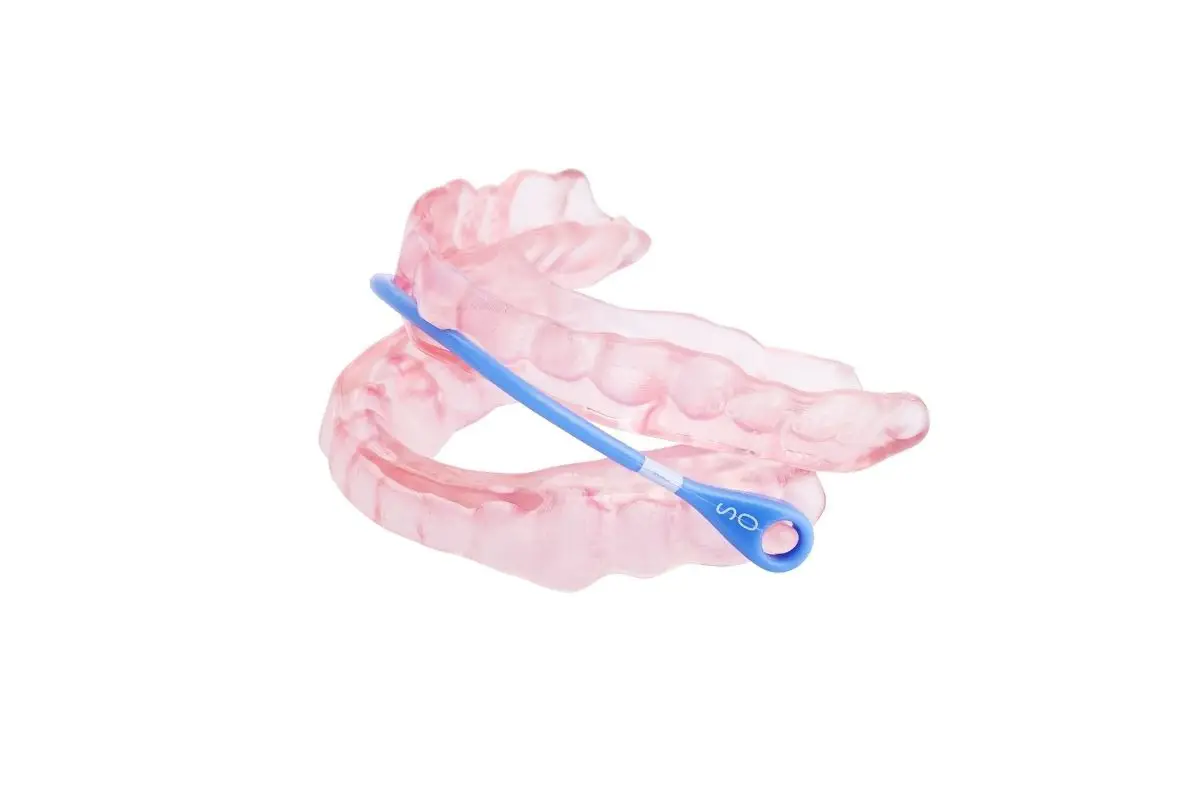
Oral Appliance Therapy is a clinically proven treatment for many adults with obstructive sleep apnea and chronic snoring. The treatment uses a custom-fitted oral appliance similar in appearance to a sports mouthguard or orthodontic retainer that is worn while you sleep.
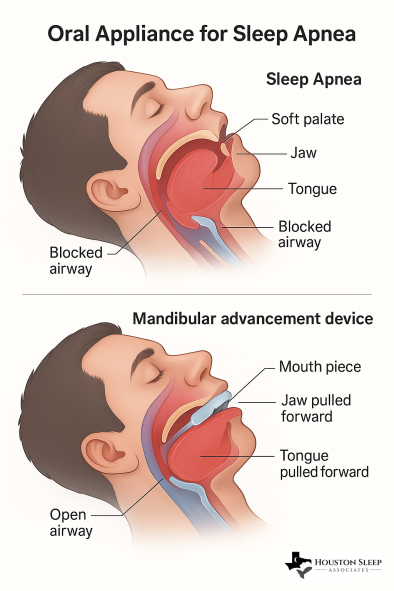
The appliance works by gently repositioning your lower jaw slightly forward. This small adjustment helps keep the airway open, reducing the likelihood that the tongue and surrounding soft tissues will collapse and restrict airflow during the night.
Unlike CPAP therapy, which relies on continuous air pressure delivered through a mask and hose, oral appliance therapy provides a quiet, comfortable, and portable solution that many patients find easier to use consistently. Because successful treatment depends on wearing your therapy every night, comfort and convenience are important factors when choosing the right treatment.
Every oral appliance at Houston Sleep Associates is custom fabricated using detailed digital impressions or dental models of your teeth. The appliance is then carefully adjusted during follow-up visits to maximize comfort, improve airway stability, and reduce breathing interruptions.
For many patients with mild to moderate obstructive sleep apnea and for some patients who have difficulty tolerating CPAP, oral appliance therapy provides an effective, evidence-based treatment that fits naturally into everyday life.
Whether you're sleeping at home, traveling for business, or taking a vacation, your appliance is small enough to fit in a protective carrying case and requires no electricity, batteries, hoses, or bulky bedside equipment.
When properly prescribed, custom-fitted, and monitored by experienced providers, oral appliance therapy can help improve sleep quality, reduce loud snoring, increase daytime energy, and support better long-term health.
Signs You May Need Oral Appliance Therapy
Many people live with obstructive sleep apnea for years without realizing it. Because the symptoms often develop gradually, they are frequently mistaken for stress, aging, or simply not getting enough sleep. In many cases, a spouse or family member notices the warning signs before the patient does.
If you experience any of the following symptoms, you may benefit from an evaluation to determine whether Oral Appliance Therapy is right for you:
- Loud, chronic snoring
- Witnessed pauses in breathing during sleep
- Waking up gasping or choking
- Excessive daytime sleepiness
- Morning headaches
- Difficulty concentrating or brain fog
- Memory problems
- Dry mouth or sore throat upon waking
- Frequent nighttime awakenings
- High blood pressure that is difficult to control
- Irritability or mood changes
- Difficulty tolerating CPAP therapy
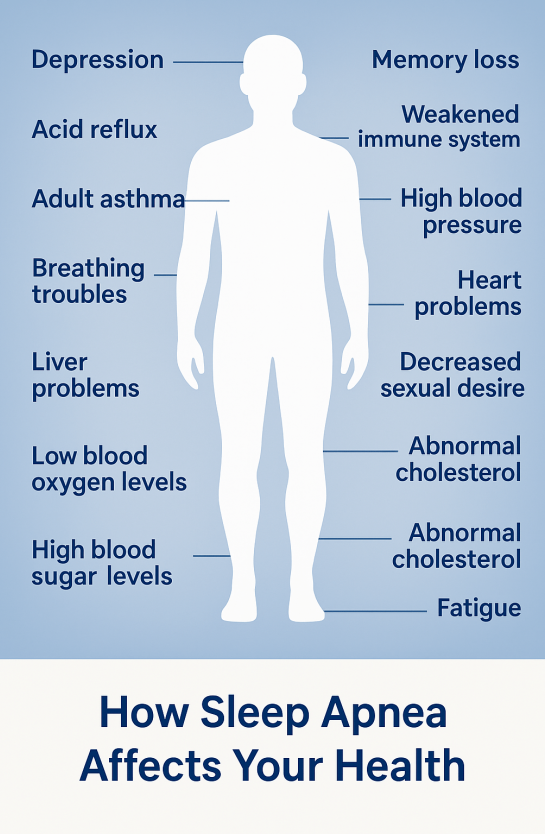
Sleep apnea affects much more than your sleep. Left untreated, it has been associated with an increased risk of cardiovascular disease, stroke, atrial fibrillation (AFib), type 2 diabetes, depression, and reduced quality of life.
The encouraging news is that effective treatment is available. A comprehensive evaluation can determine whether your symptoms are related to obstructive sleep apnea and whether a custom oral appliance is an appropriate solution for your condition.
If you've already been diagnosed with sleep apnea but have stopped using your CPAP machine because of discomfort, you're not alone. Many patients successfully transition to Oral Appliance Therapy after learning that a comfortable, non-surgical alternative is available.
Early treatment not only improves sleep quality but may also help protect your long-term health and restore the energy needed to fully enjoy work, family, and everyday life.
The encouraging news is that effective treatment is available. A comprehensive evaluation can determine whether your symptoms are related to obstructive sleep apnea and whether a custom oral appliance is an appropriate solution for your condition.
If you've already been diagnosed with sleep apnea but have stopped using your CPAP machine because of discomfort, you're not alone. Many patients successfully transition to Oral Appliance Therapy after learning that a comfortable, non-surgical alternative is available.
Early treatment not only improves sleep quality but may also help protect your long-term health and restore the energy needed to fully enjoy work, family, and everyday life.
Why Choose Oral Appliance Therapy Instead of CPAP?
For decades, CPAP therapy has been considered one of the most effective treatments for obstructive sleep apnea. By delivering a continuous stream of pressurized air through a mask, CPAP helps keep the airway open throughout the night.
While CPAP remains an excellent option for many patients, it isn't the right solution for everyone.
Some individuals struggle with mask discomfort, air leaks, dry mouth, skin irritation, machine noise, or the inconvenience of traveling with bulky equipment. Others find it difficult to sleep comfortably while wearing a mask every night, making long-term treatment challenging.
For these patients, Oral Appliance Therapy may provide an effective alternative.
Rather than using air pressure, a custom oral appliance gently repositions the lower jaw to help keep the airway open naturally while you sleep. The appliance is small, lightweight, and custom fitted to your teeth, allowing many patients to wear it comfortably throughout the night.
Many patients appreciate that oral appliance therapy offers several practical advantages, including:
Common CPAP complaints include:
- Mask discomfort
- Claustrophobia
- Dry mouth
- Noise disruption
- Difficulty traveling
- Poor compliance
- Air leaks
- Skin irritation
Benefits of oral appliance therapy include:
- No mask covering your face
- No hoses or bedside machine
- No electricity required
- Quiet operation
- Easy to pack for travel
- Comfortable custom fit
- Simple nightly routine
- Easy cleaning and maintenance
How Oral Appliance Therapy Works
Beginning treatment with Oral Appliance Therapy is a straightforward process that provides a comfortable, personalized solution for your obstructive sleep apnea. Every treatment plan is customized to your individual needs, ensuring your appliance fits properly and delivers the best possible results.
Step 1: Comprehensive Evaluation
Your first appointment begins with a thorough review of your medical history, sleep study, current symptoms, and previous treatment experience. We evaluate your airway, jaw alignment, bite, and overall oral health to determine whether oral appliance therapy is the right option for you.
Step 2: Digital Impressions
If you're a good candidate, we take precise digital scans or dental impressions of your teeth. These measurements allow your custom appliance to be fabricated specifically for your mouth, providing a secure and comfortable fit.
Unlike over-the-counter devices, every appliance is individually designed for your unique bite and airway anatomy.
Step 3: Custom Appliance Delivery
Once your appliance is ready, you'll return for a fitting appointment.
During this visit, we'll:
- Confirm the appliance fits properly.
- Make initial adjustments for comfort.
- Review how to insert and remove the appliance.
- Explain cleaning and maintenance.
- Answer any questions about treatment.
Most patients adapt to wearing their appliance surprisingly quickly.
Step 4: Follow-Up Care
Successful treatment doesn't end when you receive your appliance.
Follow-up appointments allow us to monitor your progress and make small adjustments that improve both comfort and effectiveness.
During these visits, we evaluate:
- Symptom improvement
- Snoring reduction
- Appliance fit
- Jaw comfort
- Bite changes
- Overall treatment success
In some cases, your physician may recommend a follow-up sleep study to confirm that treatment is effectively managing your sleep apnea.
Our goal is not simply to provide an oral appliance—it's to help you achieve healthier sleep for years to come through ongoing care and personalized treatment.
Can Oral Appliance Therapy Stop Snoring?
For many patients, yes. Loud, chronic snoring is often caused by the vibration of soft tissues in the throat when the airway partially narrows during sleep. As airflow becomes restricted, these tissues vibrate, creating the familiar snoring sound that can disrupt both your sleep and your partner's.
Oral Appliance Therapy helps reduce snoring by gently repositioning the lower jaw, helping to keep the airway open throughout the night. By improving airflow and reducing airway collapse, many patients experience a significant reduction in both the frequency and intensity of snoring. For couples, the benefits often extend beyond better breathing. Quieter nights can lead to improved sleep quality for both partners, fewer nighttime disruptions, and a better overall quality of life.
However, it's important to understand that loud snoring is sometimes more than just a nuisance. Persistent snoring—especially when combined with pauses in breathing, choking, gasping during sleep, or excessive daytime fatigue—may be a sign of obstructive sleep apnea. That's why we recommend a comprehensive evaluation before treating snoring alone. Identifying the underlying cause allows us to recommend the most appropriate treatment for your specific condition rather than simply masking the symptom.
If your snoring is related to obstructive sleep apnea, treating the underlying breathing disorder not only helps reduce snoring but may also improve your sleep quality, increase daytime energy, and reduce the long-term health risks associated with untreated sleep apnea. Whether your primary concern is snoring, poor sleep, or a previous diagnosis of sleep apnea, our team can help determine whether Oral Appliance Therapy is the right solution for you.
Did You Know?
Nearly every patient who seeks treatment for loud snoring should also be evaluated for obstructive sleep apnea, because snoring is one of its most common warning signs.
Who Is a Candidate for Oral Appliance Therapy?
Not every patient with obstructive sleep apnea requires the same treatment. One of the most important parts of your evaluation is determining which therapy best matches your airway anatomy, medical history, lifestyle, and treatment goals.
You may be a good candidate for Oral Appliance Therapy if you:
- Have mild to moderate obstructive sleep apnea
- Have been diagnosed with sleep apnea but cannot comfortably tolerate CPAP therapy
- Snore loudly on a regular basis
- Wake up feeling tired despite a full night's sleep
- Travel frequently and want a portable treatment option
- Prefer a quiet, non-surgical solution
- Have healthy teeth and gums capable of supporting a custom appliance
- Want an alternative to wearing a CPAP mask every night
Many patients assume they have only two choices: continue struggling with CPAP or leave their sleep apnea untreated.
Fortunately, that isn't the case.
A custom oral appliance provides an evidence-based treatment option that many patients find significantly easier to wear every night. Because successful treatment depends on consistency, finding a therapy that fits comfortably into your lifestyle is often one of the biggest factors in achieving long-term success.
Even patients with more advanced sleep apnea may be candidates for oral appliance therapy in certain situations. Treatment decisions are based on several factors, including your sleep study, airway anatomy, overall health, and recommendations from your healthcare team.
During your consultation at Houston Sleep Associates, we'll carefully review your previous testing, discuss your symptoms, evaluate your airway, and determine whether oral appliance therapy is an appropriate solution for your specific needs.
If oral appliance therapy isn't the best option, we'll explain why and discuss other evidence-based treatments that may be more appropriate. Our goal is always to recommend the treatment that offers the greatest opportunity for long-term success—not simply the same treatment for every patient.
Physicians: Refer Patients for Sleep Apnea Treatment
Houston Sleep Associates understands your frustration when patients cannot tolerate a CPAP, and we are here to help. Our first encounter with patients involves an in-depth discussion to understand why they are not using their CPAP. We also confirm that the patient is aware of the dreadful consequences of discontinuing CPAP use. Finally, we stress that they consider a renewed effort to adapt to CPAP. If that is impossible, we will proceed with the oral appliance evaluation.
Why Patients Choose Houston Sleep Associates
Choosing the right provider for Oral Appliance Therapy is just as important as choosing the right treatment. At Houston Sleep Associates, we believe successful sleep apnea care begins with understanding each patient's unique needs—not applying the same solution to everyone.
Our approach combines evidence-based treatment, personalized care, and ongoing follow-up to help patients achieve long-term success. From your initial consultation through every adjustment appointment, our focus is on improving your sleep, protecting your overall health, and providing a treatment plan that fits comfortably into your lifestyle.
When you choose Houston Sleep Associates, you benefit from:
- Personalized treatment plans based on your sleep study and medical history
- Custom-fabricated oral appliances designed specifically for your bite
- Comprehensive airway and oral health evaluations
- Collaboration with your physician and other healthcare providers when appropriate
- Precise adjustments to maximize comfort and effectiveness
- Ongoing follow-up appointments to monitor long-term success
- A conservative, evidence-based approach to treating obstructive sleep apnea
- A team committed to helping you achieve better sleep and improved quality of life
We understand that many patients come to us after struggling with CPAP therapy or feeling frustrated by poor sleep. Our goal is to listen carefully, answer your questions, and recommend the treatment that offers the greatest opportunity for long-term success.Whether you're seeking relief from loud snoring, looking for an alternative to CPAP, or exploring treatment options after a recent diagnosis, we're here to help you make informed decisions about your sleep health with confidence.
We focus on:
- Comprehensive patient education
- Customized treatment planning
- Advanced airway-focused care
- Comfortable, modern solutions
- Long-term treatment success
- Convenient Houston-area care
We proudly serve patients throughout Houston, River Oaks, West University, Bellaire, Memorial, Montrose, Upper Kirby, The Heights, Rice Military, Spring Branch, Galleria, Meyerland, Braeswood, Medical Center, Midtown, Downtown Houston, Sugar Land, Missouri City, Pearland, Friendswood, Pasadena, Katy, Cinco Ranch, Cypress, Jersey Village, Tomball, Spring, The Woodlands, Conroe, Kingwood, Humble, Atascocita, Clear Lake, League City, Webster, Richmond, Rosenberg, Fulshear, and surrounding Southeast Texas communities.
Find Us
You can also email or fax us at any time, and someone will contact you shortly to accommodate your request. Please use the map below to plan your route to our dental office.
Phone: 281.378.4999
Fax: 713.522.7664
Address
2150 Richmond Ave. #101 Houston, TX 77098
Do you have questions about sleep apnea treatment, snoring solutions, or CPAP alternatives? We're here to help.
Schedule a Sleep Apnea Consultation in Houston
If you are searching for a comfortable CPAP alternative or effective sleep apnea treatment in Houston, oral appliance therapy may help you achieve healthier sleep and improved overall wellness. Houston Sleep Associates provides customized oral appliance therapy solutions designed to improve breathing, reduce snoring, and help patients sleep more comfortably and confidently. Contact Houston Sleep Associates today to schedule your consultation and learn whether oral appliance therapy is right for you.
Frequently Asked Questions
TMJ disorder (TMD) is a condition affecting the jaw joint and surrounding muscles, causing pain, dysfunction, and limited movement.
Mild cases may improve, but many require professional treatment to prevent symptoms from worsening.
Most TMJ treatments are non-invasive and designed to relieve pain—not cause it.
Relief can begin within weeks, but full treatment depends on severity.
Yes—TMJ is a common cause of chronic headaches and migraines.
Yes, jaw positioning and airway issues often connect TMJ and sleep disorders.